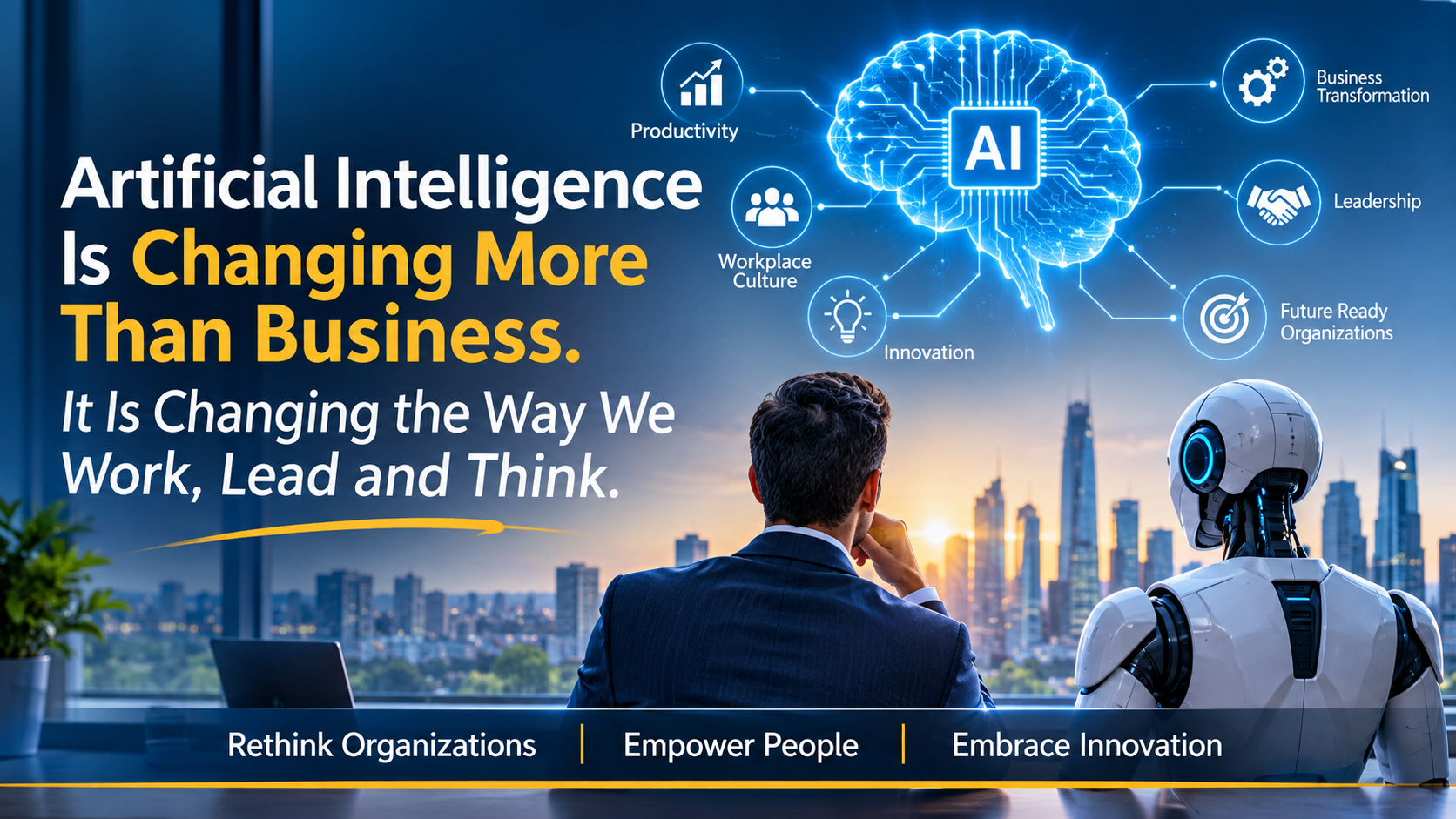
Personal reflections on the future of corporate organizations, leadership and workplace culture.
Having spent more than 25 years in the corporate sector, working across business development, strategic management, operations, organizational development and leadership roles, I have witnessed several significant shifts in the way businesses operate.
I have seen organizations move from manual processes to digital systems, from traditional communication channels to integrated enterprise platforms, and from relationship-driven business models to increasingly data-driven decision-making. Every phase brought its own challenges, opportunities and resistance to change.
However, what we are witnessing today with Artificial Intelligence (AI) is fundamentally different.
AI is not simply another technological upgrade. It is becoming a force that is reshaping the very foundations of corporate organizations, challenging conventional management practices, redefining employee responsibilities and changing our understanding of productivity, leadership and workplace culture.
My observation is that we are entering a period in which the traditional corporate playbook will increasingly become inadequate. Organizations that understand this shift and adapt their structures, people and processes will have a significant advantage over those that continue operating with yesterday’s management philosophies.
I would like to share a few observations from a corporate leadership perspective.
1. AI Is No Longer Just a Technology Department’s Responsibility
One of the biggest misconceptions about AI is that it should primarily be managed by IT departments. This may have been understandable during the early stages of digital transformation, but the situation has changed considerably.
AI is now relevant to almost every business function. From finance and human resources to procurement, engineering, marketing, business development, project management and customer relations, its applications are becoming increasingly practical.
Consider a conventional business development department. Market research, competitor analysis, proposal preparation, customer profiling, financial modelling and business forecasting traditionally required considerable manpower and time. Today, AI-enabled tools can accelerate many of these activities, allowing professionals to concentrate more on strategic thinking, commercial negotiations and relationship management.
The same applies to engineering and operations. Predictive maintenance, equipment monitoring, technical documentation, inventory optimization and operational reporting can all benefit from intelligent systems.
This means AI adoption cannot remain an isolated IT initiative. It needs to become part of the organization’s overall business strategy.
The real question for corporate leaders should no longer be whether their organization is using AI. It should be whether AI is helping the organization achieve better business outcomes.
2. The Changing Workplace and Corporate Culture
Perhaps the most interesting impact of AI will not be on technology itself but on workplace culture.
For decades, corporate organizations have operated around relatively established structures. Departments have defined responsibilities, employees have specific job descriptions, managers supervise teams, and performance is frequently measured through working hours, reporting structures and deliverables.
AI is challenging many of these conventions.
When employees can automate routine activities, generate reports, analyze information and prepare initial drafts within minutes, the traditional relationship between time spent and value delivered begins to change.
Productivity is no longer simply about how many hours someone works. It is increasingly about the quality of outcomes they produce.
This will require organizations to rethink their performance management systems. Measuring employees purely through attendance, working hours or the volume of routine tasks completed will become increasingly disconnected from actual business contribution.
I believe organizations will gradually move towards an outcome-oriented culture where creativity, problem-solving, decision-making, collaboration and measurable business impact carry greater weight.
There is another important dimension to this change. Employees who previously spent a significant portion of their time on administrative activities will increasingly be expected to contribute towards higher-value assignments.
This can be an opportunity for both organizations and employees, provided leadership creates the right environment.
3. The Traditional Organizational Hierarchy Will Be Challenged
Traditional corporate structures were largely designed around information control.
Information moved upwards through reporting channels, decisions came down through management hierarchies, and different departments operated within their defined boundaries.
AI is changing this equation.
Access to information, analytical capabilities and business intelligence is becoming more widely available. Employees at different organizational levels can now access tools that were previously available only through specialist departments or senior management resources.
A middle-level manager can prepare a market assessment, analyze financial scenarios or develop a business proposal with considerably greater speed. A project manager can use AI to identify potential scheduling conflicts, prepare risk assessments and improve reporting.
This does not eliminate the importance of management. It changes what effective management should look like.
Organizations may increasingly move towards leaner structures, cross-functional teams and more decentralized decision-making. The value of a manager will be determined less by how much information they control and more by how effectively they guide people, resolve problems and deliver results.
However, flattening organizational structures should not be confused with removing accountability. Clear authority, governance and responsibility will remain essential.
4. Leadership Will Need a Different Mindset
In my experience, successful organizations are rarely defined by their technology alone. They are defined by the quality of their leadership and their ability to adapt to changing circumstances.
AI makes this observation even more relevant.
Corporate leaders cannot expect their organizations to embrace transformation if they themselves are unwilling to understand and experiment with new technologies.
I believe the next generation of effective leaders will need to demonstrate three important characteristics.
First, technological awareness. They do not necessarily need to become AI specialists or understand every technical detail, but they must know what AI can do, where it can create value and where its limitations exist.
Second, adaptability. Leaders must be prepared to question established processes and management practices. Something that worked successfully for twenty years may no longer be the most efficient approach.
Third, people-centric leadership. As technology takes over more repetitive activities, human capabilities such as emotional intelligence, negotiation, judgement, communication and relationship management will become even more important.
There is a distinction between managing technology and leading people through technological change. The latter is where effective leadership will make the greatest difference.
5. Human Intelligence Will Become More Valuable, Not Less
There is considerable discussion about whether AI will replace employees. I believe this debate needs a more balanced perspective.
Yes, certain jobs and activities will be automated. Some traditional roles will shrink, while others will evolve or disappear. At the same time, entirely new responsibilities and opportunities will emerge.
But organizations should not make the mistake of assuming that technological capability automatically translates into sound business judgement.
AI can process information, identify patterns, generate recommendations and produce impressive outputs. However, business decisions often involve circumstances that cannot be fully understood through data alone.
Consider a complex commercial negotiation, a government infrastructure project, a strategic partnership or a difficult employee-management situation.
These situations require an understanding of relationships, institutional behaviour, cultural sensitivities, commercial realities and sometimes even the unspoken factors influencing a decision.
Technology can support the process, but human judgement remains central.
I believe the real competitive advantage will belong to professionals who combine industry experience, critical thinking and relationship management with the effective use of AI.
The future will not necessarily belong to those who know the most about technology. It will belong to those who know how to use technology intelligently.
6. Skills Will Matter More Than Traditional Job Titles
One of the most significant changes I anticipate is the gradual shift from role-based thinking towards capability-based organizations.
Traditionally, recruitment and career progression have been strongly influenced by qualifications, experience, job titles and clearly defined responsibilities.
These factors will continue to matter, but organizations will increasingly look for people who can adapt, learn new tools, solve complex problems and work across different disciplines.
An employee who understands business operations and can effectively use AI to improve processes may create considerably more value than someone who simply performs a narrowly defined administrative function.
Similarly, a business development professional who combines industry knowledge, commercial understanding, market intelligence and AI-enabled research will have a stronger competitive position.
This also places a responsibility on employees.
Learning cannot remain something that happens only during formal training sessions or occasional professional development programmes. It needs to become part of everyday working life.
The half-life of certain professional skills is becoming shorter. What makes someone relevant today may not be sufficient five years from now.
Organizations that invest in continuous learning will be better positioned to retain talent and develop future leaders.
7. AI Will Redefine Operational Efficiency and Business Performance
From an organizational perspective, one of the most immediate benefits of AI is its potential to improve efficiency.
Every organization has processes that consume time without necessarily creating proportionate value. Repetitive reporting, documentation, information gathering, data entry, routine correspondence and administrative coordination are common examples.
AI can help streamline many of these activities.
In industries such as aviation, infrastructure, construction, manufacturing and facility management, the possibilities are particularly interesting.
For example, AI-enabled predictive maintenance can help identify potential equipment failures before they develop into major operational problems. Intelligent inventory systems can improve stock planning and reduce unnecessary procurement. Automated document analysis can accelerate contract reviews and technical compliance assessments.
Similarly, organizations managing large infrastructure projects can use AI to support project scheduling, risk identification, resource planning and progress monitoring.
However, there is an important distinction between automation and transformation.
Automating an inefficient process does not necessarily make the organization more efficient. It may simply allow the organization to perform the same inefficient activity more quickly.
The real opportunity lies in redesigning business processes around what technology makes possible.
This requires leadership to examine workflows, eliminate unnecessary activities and rethink how different departments collaborate.
The objective should not simply be to reduce operating costs. It should be to improve organizational capability, responsiveness, quality and long-term competitiveness.
8. The Challenges: Resistance, Trust and Accountability
Despite its enormous potential, AI adoption will not be without challenges.
One of the biggest obstacles will be organizational resistance.
Employees may feel threatened by automation, particularly when they are uncertain about the future of their roles. Managers may resist technologies that challenge established authority or expose inefficiencies in existing processes.
There may also be concerns about data confidentiality, intellectual property, cybersecurity, inaccurate outputs and the ethical use of AI.
These are legitimate concerns and should not be dismissed as resistance to progress.
Organizations need clear AI governance frameworks defining what tools employees can use, what information can be shared, how AI-generated outputs should be verified and who remains accountable for decisions.
A particularly important principle is that responsibility cannot be outsourced to an algorithm.
If an AI-assisted financial assessment contains an error, someone must remain accountable for reviewing it. If an AI-generated technical recommendation is incorrect, professional judgement and appropriate verification must take precedence.
Corporate organizations must establish a culture where AI is encouraged but not blindly trusted.
The objective should be responsible adoption rather than uncontrolled experimentation.
9. What Should Corporate Leaders Do Now?
Based on my observations, organizations should approach AI transformation as a strategic business priority rather than a technology procurement exercise.
I would suggest the following priorities for senior management:
1. Develop an organization-wide AI strategy.
Identify the business functions where AI can deliver measurable value and establish clear objectives for implementation.
2. Lead by example.
Senior executives and department heads should actively explore AI applications in their own areas of responsibility. Employees are more likely to embrace change when they see leadership demonstrating genuine commitment.
3. Invest in employee development.
Provide practical training that enables employees to use AI in their everyday responsibilities. Training should be relevant to actual business functions rather than limited to generic technology awareness.
4. Redesign business processes.
Review existing workflows and identify opportunities to eliminate duplication, reduce administrative burdens and improve decision-making.
5. Establish responsible AI governance.
Develop clear guidelines covering data protection, information security, accuracy, accountability and ethical use.
6. Redefine performance management.
Gradually move towards measuring productivity, quality, innovation and business outcomes rather than relying excessively on traditional activity-based indicators.
The responsibility rests with corporate leadership to ensure that this transformation is thoughtful, inclusive and strategically aligned.
7. Encourage experimentation.
Create an environment where employees can test ideas, share experiences and learn from unsuccessful initiatives without unnecessary fear of criticism.
These steps may appear straightforward, but their implementation requires commitment from the highest levels of management.
10. The Next Decade Will Belong to Organizations That Learn Faster
Looking ahead, I believe the next decade will create a significant divide between organizations that simply adopt AI tools and those that fundamentally transform the way they operate.
The difference will not necessarily be determined by the size of their technology budgets.
It will be determined by their ability to learn, adapt and integrate technology into their organizational culture.
A company may invest heavily in AI platforms and still fail to achieve meaningful results if its employees are not trained, its management is not aligned and its business processes remain unchanged.
On the other hand, an organization with a clear strategy, capable leadership and an adaptable workforce can achieve substantial improvements without necessarily making massive technology investments.
A recent Microsoft 2026 Work Trend Index, based on a global survey of approximately 20,000 AI users across ten markets, highlighted an important finding: organizational factors such as workplace culture, manager support and talent practices accounted for more than twice the reported AI impact of individual factors.
This reinforces a point that I consider fundamental: AI transformation is as much about people and organizational culture as it is about technology.
The companies that succeed will be those that recognize this distinction early.
Conclusion:
Technology Will Change the Workplace, But Leadership Will Define Its Future After more than 25 years in the corporate environment, I have learned that organizations do not transform simply because new technologies become available. They transform when their leadership recognizes the need for change, communicates a clear direction and creates the conditions for people to embrace it.
AI is presenting us with another such moment, perhaps one of the most significant in modern business history.
It will change job descriptions, reporting structures, business processes, productivity expectations and the way organizations compete. It will challenge conventional thinking and require employees at every level to reconsider how they create value.
But I do not believe the future of business should be viewed through the lens of technology replacing people.
Instead, we should focus on how technology can enable people to achieve more, make better decisions and contribute at a higher level.
My takeaway is simple: Don’t just introduce AI into your organization. Rethink your organization for the AI era.
Because the real competitive advantage will not come from having access to AI. It will come from knowing how to combine artificial intelligence with human intelligence, experience and leadership.
The future belongs to organizations that understand both.